
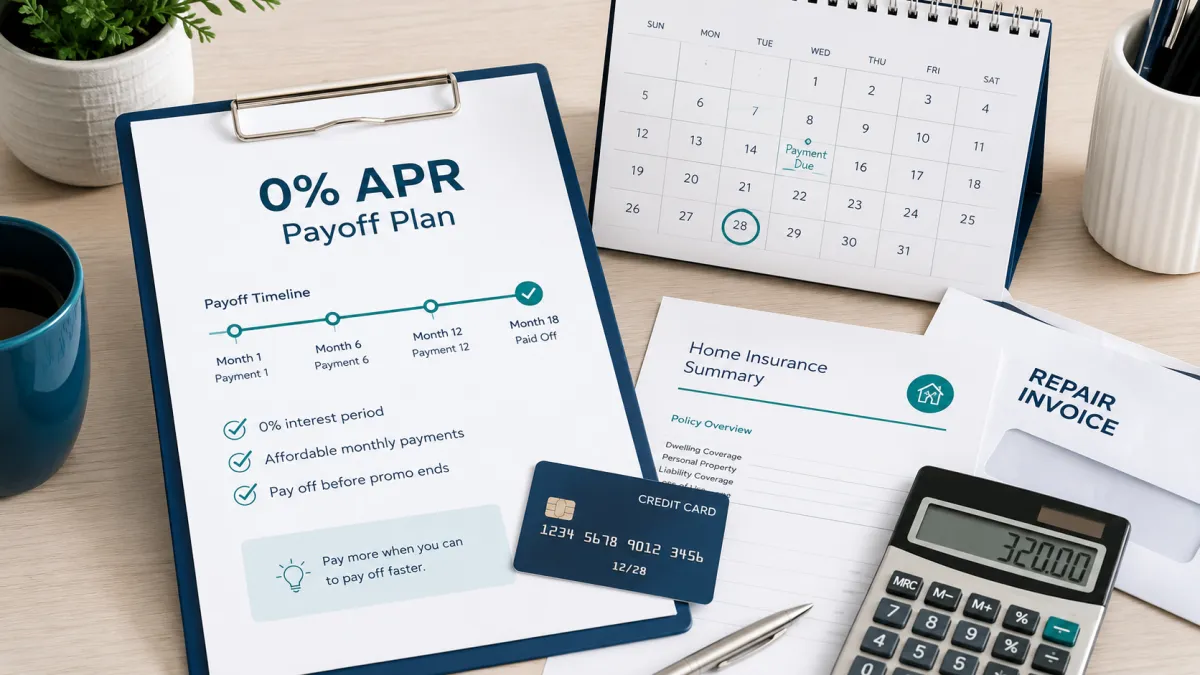
When Does a 0% APR Credit Card Actually Make Sense?
A 0% APR credit card can be a useful tool, but the zero can make it easy to focus on the wrong thing.
The question is not simply, “Can I spread this expense out without paying interest?”
I think the better question is:
Why am I using the 0% offer, and do I know how I’m going to pay it off?
Used thoughtfully, a 0% purchase APR offer can create flexibility around an expense you need to cover. That could be something you knew was coming or an unexpected necessary expense.
Used casually, it can also make a purchase feel easier to afford simply because the monthly payment looks manageable.
Start With the Reason for the Expense
For me, this is the first test.
Is there a real reason for the expense, or is the 0% offer making it easier to justify spending money you otherwise would not have spent?
There is a meaningful difference between using 0% APR for an insurance premium, a necessary home repair, a medical expense, or another expense you need to handle and using it to justify a purchase simply because you can spread the payments out.
A $6,000 purchase does not become cheaper because you can divide it across a promotional period. The 0% offer changes the timing of the payments, not the cost of the purchase itself.
That is why I like to think of it this way:
The money should have a job.
Sometimes you know what that job is months ahead of time. Sometimes life decides for you. Either way, you still need a plan for getting the balance back to zero.
A Real Example: Paying Insurance Upfront
My mom recently had a good reason to use this strategy.
She had home and auto insurance premiums she was going to pay either way. Her insurance company offered a discount for paying the policies upfront instead of making monthly payments.
Paying the full premiums at once lowered the cost of the insurance, but she still preferred paying for that expense monthly.
So she used a credit card with a 0% purchase APR offer to pay the policies upfront. She received the paid-in-full discount, then set up monthly payments so the card will be paid off before the promotional period expires.
What I especially like is that the strategy created three layers of value from the same expense.
First, she saved money on the insurance by qualifying for the paid-in-full discount.
Second, the 0% APR offer allowed her to keep paying monthly instead of having the entire annual premium hit her cash flow at once.
Third, the card earned points on an expense she already had, and those points ultimately got her a flight.
That is a pretty good trifecta.
But the order matters. She did not buy more insurance to earn points, and she has a plan to pay the balance off before the promotion ends.
The insurance savings came first. The 0% APR gave her flexibility. The rewards were the additional benefit.
A cash-back card with a qualifying 0% purchase APR offer could accomplish something similar.
This is a good example of strategic spending: finding more than one source of value in spending that was already going to happen.
Not Every Expense Has to Be Planned
Of course, life does not always give us months to plan.
A roof starts leaking. Your car needs a significant repair. A medical expense comes up. An appliance needs to be replaced sooner than expected.
In situations like these, a 0% APR offer can provide useful breathing room if the payments fit your budget and you have a realistic path to paying the balance off before the promotional period ends.
What matters is why you are using it, whether the monthly payment is manageable, and what your payoff plan looks like.
Your Minimum Payment Is Not Your Payoff Plan
A 0% promotional period has an end date. Your payoff plan should have one too.
I would not simply make the minimum payment and assume the balance will take care of itself.
Instead, look at the amount you charged and the length of the promotional period, then determine what monthly payment gets you to $0 before the offer expires.
I also like leaving a little cushion. If you have 15 months of 0% APR, for example, I would rather have the balance gone in 13 or 14 months than rely on the final payment at the last possible moment.
And pay attention to the terms of the offer you actually have: when the promotional period ends, what APR applies afterward, any applicable fees, and the payment requirements.
You do not need to become an expert in credit-card fine print. You do need to know what you agreed to.
Where I Would Be More Cautious
A 0% APR offer becomes much less useful when there is no clear path to paying the balance off.
I would be cautious if you are already carrying significant credit-card balances or if adding another monthly payment would make your budget uncomfortable.
Sometimes the point is to create flexibility around a necessary expense.
And if you use the same card for other purchases or transactions, pay attention to the card’s terms. Different transactions can be treated differently depending on the promotional offer.
A Simple 0% APR Check
Before I would use a 0% APR card for an expense, I would ask four questions.
1. Why am I using 0% APR for this expense?
Maybe paying upfront saves money. Maybe an unexpected necessary expense came up and spreading the cost gives you breathing room.
2. What specific benefit am I getting from the 0% offer?
In my mom’s case, paying upfront reduced the cost of the insurance while the 0% APR offer let her keep paying monthly.
3. What payment gets the balance to $0 before the promotion ends?
Set your payment based on your payoff deadline, not simply the minimum payment. If you can, leave yourself a little room before the final promotional month.
4. What happens if my plan changes?
Know how much flexibility you have in your budget and what the terms say will happen if a balance remains after the promotion ends.
0% APR Is a Tool, Not the Strategy
I do not think 0% APR is automatically good or bad.
It can be a smart way to manage an expense when there is a clear reason for using it, the terms are understood, and the payoff plan is in place.
That could be something you knew was coming, an opportunity to save money by paying something upfront, or an unexpected expense you need to handle.
It can become a problem when the promotional rate is what convinces you that a purchase you cannot really afford suddenly fits the budget.
The difference is not the 0%.
The difference is the plan behind it.
Could a 0% APR Card Make Sense for a Large Expense?
My mom’s insurance example worked because several pieces lined up: paying upfront reduced the cost, the 0% APR offer let her spread the payments back out, and the card earned rewards on spending she already needed to do.
Not every expense will check all three boxes.
But if you have a large expense coming up, an unexpected necessary expense to handle, or an opportunity to save money by paying something upfront, a 0% APR card may be worth considering.
Before applying, look at the promotional period, any fees, the APR that applies afterward, the rewards the card earns, and most importantly, whether the payoff comfortably fits your budget.